Ensemble Practice In the ensemble practice, dancers compose with one another. This is a complex system in which the dancers’ personal movement vocabularies are embedded within compositional patterns or structures, and emergent structures are embedded within larger organizational patterns that we are calling forms.
While making choices in the present moment, an improviser attends to multi-levels of organization: local, regional, and global, while focusing on movement patterns, spatial relationships, signals from the other performers, and development over time. With an articulate solo movement vocabulary, a dancer is able to bring ideas into quick-moving windows of opportunity in ensemble improvisations. The ensemble engages in a constant selection and refinement of material while, in a process of trial and error, they focus on the emergence of the material and how it is being shaped.
Signaling techniques are essential tools for non-verbal feedback while selecting and developing patterns during the improvisation. They develop amongst the performers and support global, collective, self-organizing behavior that mirrors the selection and pruning process that occurs in complex systems in nature. For examples, the focus and direction of the eyes can indicate connection and location of attention in space. Dynamics and speed of gesture, as well as touch, can signal rhythm, tone, and timing.
Waves and Eddies - video by Colin Brant
Compositional Tools
Compositional tools are practices that enable the individual dancer and the ensemble to build and recognize complex structures, which in turn enable them to build and recognize more encom- passing complex forms.
Tools for establishing basic patterns and relationships within movement material include: Unison, Spatial Patterns, Solo/Chorus, Retrograde, Rhythmic Patterns, Narratives/Images, Foreground/Background, Repetition, Interruptions, Sudden Changes, Entrances/Exits, Stillness, Shadowing, Partnering, Framing.
Referencing brings back or repeats an earlier compositional choice in order to emphasize or contextualize its meaning. A dancer can reference a gesture, quality, spatial pattern, or narra- tive. The ensemble can also reference patterns that have previously emerged within a composition.
Amplification occurs when a movement is made by one dancer and is subsequently mimicked by several dancers through- out the space. It often serves to visually multiply a gesture and quickly establish an ensemble pattern.
Nesting is the practice of shifting attention between the local, small group, and whole space until one is able to sustain awareness on all at once. We also call this a topology—the spatial- temporal relationship among elements and their interactions —where the improviser is tracking and mapping this information at all levels simultaneously.
Emergent Structures
In the ensemble practice, we define a “structure” as a set of patterns in an interactive relationship. Space, time, and movement are elements of these relationships. Structures emerge, morph, dissolve, and shape the development of the composition. A struc- ture can appear within a larger form or emerge into or become a form in itself, depending on its complexity and the scale of its developmental arc.
The following Emergent Structures have repeatedly occurred in our practice:
Wash: A pattern where the ensemble crosses the space together at an even energy and speed, allowing individual dancers to drop out when they wish and drop back in on a subsequent crossing. Variations occur when the dropouts improvise movement phrases, or interact with each other from across the space.
Charge: A Charge is a group impulse. It usually has high energy and speed, e.g., a mass movement across the space.
Main Event/Chorus: This pattern is very common in EI. The activity in space becomes more ordered as attractors set up a “hot spot” or main event, where the focus of the complex pattern resides. Like a Greek chorus, the others comment, respond, frame, react, or other- wise relate to the performers in the Main Event.
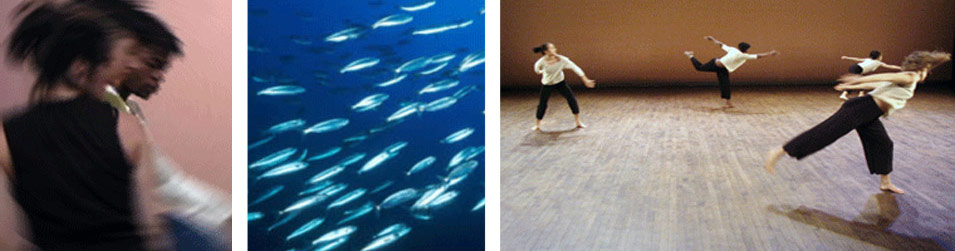
Waves and Eddies: A pattern where the ensemble travels together forwards and backwards through space, using unison movement patterns with constantly varying energy. Often originating on a long diagonal, smaller ensembles separate out from the wave like shells suspended in eddies.
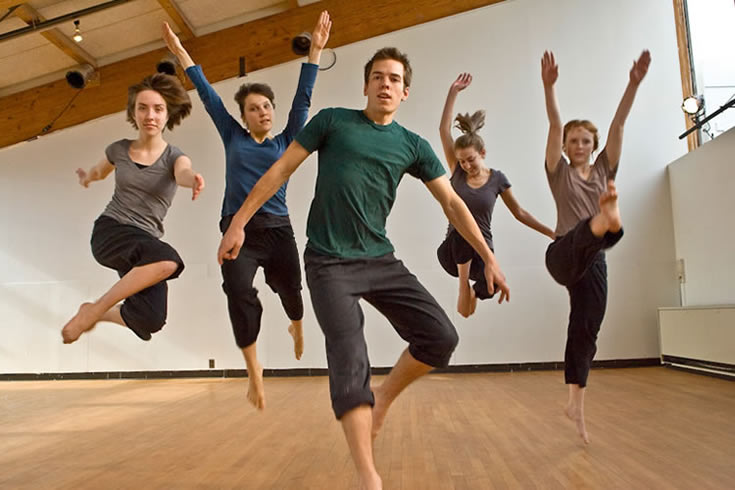 Above: from left to right: Corina Dalzell, Lydia Chrisman, Nikolaus Tsocanos, Marie Lynn Haas, Emily Climer
at Bennington College, 2011.
Pathways appear in various ways. They can be structured through travelling geometrically through space, through focusing attention or gesture along a trajectory, or by standing in a group configuration.
Landscape is a global pattern and appears when the visual rhythms and textures of the ensemble movement create a set of spatial relationships that fill the whole space, recalling attributes of a natural landscape. Relationships include symmetry or asymmetry, foreground/background, varying levels in space, stillness and moving.
Field is a type of landscape that involves a scattering of dancers throughout the space. Just as fields of daisies, wheat, or evergreens have different characteristics, an ensemble of performers can create a variety of fields with different textures, speeds, and levels of energy. Fields give a sense of critical mass to the space.
Tableau is a structure that develops visual imagery. An image can be abstract, relating to lines and geometry, or relate to specific content contained in a narrative. Dancers can build a tableau by accumulation or spontaneously all together. Tableaux contain their own logic, sometimes task-oriented, sometimes surreal. Some appear as still poses, and others are in motion.
Glacial Erratic: A structure in which a large ensemble, in their travel, leaves behind a small ensemble that further articulates the large group material and resolves the composition.